
WHITE PAPER II
"I Didn't Know What It Meant": Ignorance, Accountability, and the Cost of Erasing the Truth of Our Nation’s Racist History
A follow-up to: Don't Be Surprised — Anti-Blackness, Cross Burnings, and Racial Terror Don't Stop at the Mason-Dixon Line (June 11, 2026)
Written by: Gina E. Miranda Samuels
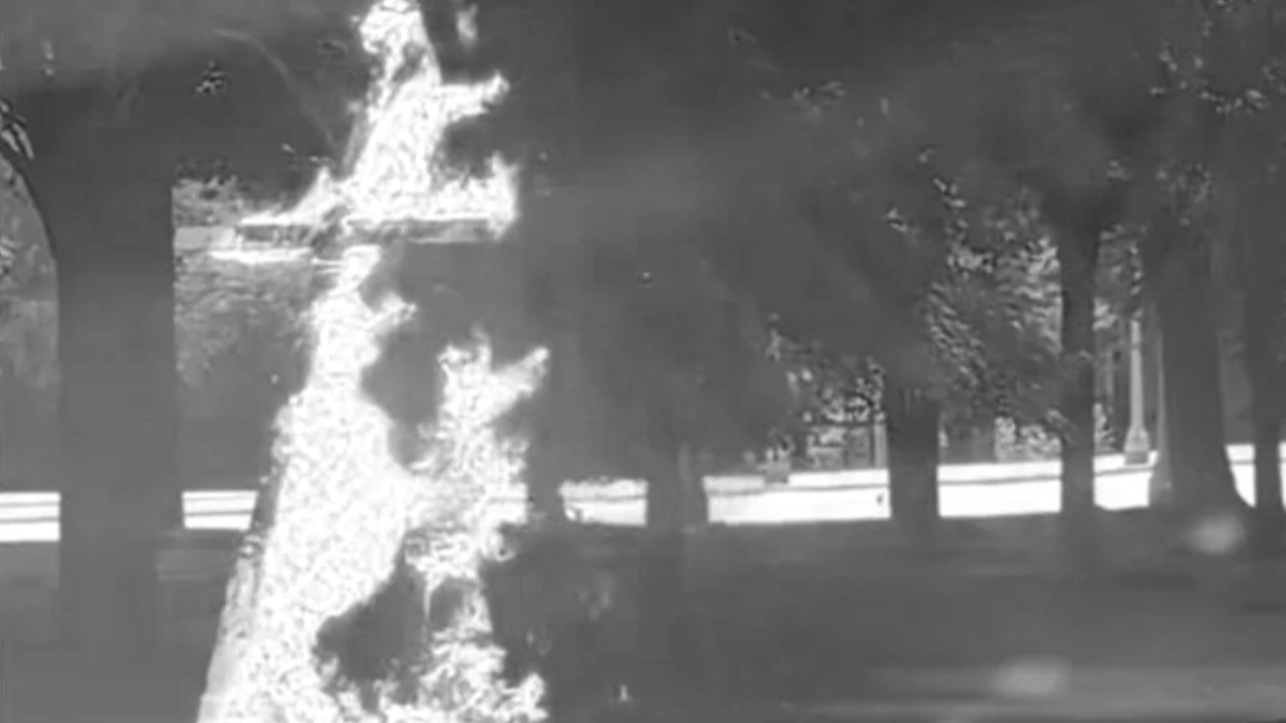
Credit: Keinika Carlton | June 9, 2026.
WHAT WE NOW KNOW
On June 18, 2026, nine days after a burning cross was discovered in Chicago's Grant Park, a 21-year-old man named Merlin Lu was charged with four felonies, including hate crime charges, arson, and property damage, and four misdemeanors in connection with the incident. Court records reveal that Lu constructed the cross with a hammer and nails, wrapped it in toilet paper, doused it with kerosene, then attached a red "Make America Great Again" hat, and set it on fire. He later told authorities he wanted to send a political message to the Trump administration. The act was not intended to be a racist message.
Citing his lack of criminal history and his voluntary surrender to police, the court determined that the conditions were not sufficient to warrant detention. So, the judge ordered Lu's release from custody pending trial. He is now under pretrial supervision.
In a subsequent interview with NBC, Lu stated: "In no way possible was that a hate crime. I understand why it was interpreted that way, and I apologize for that, but no, the intent was not there." Lu’s statement requires serious examination. Not of his character, but of what it reveals about a society that has methodically dismantled the education and societal conditions necessary for understanding why a burning cross is never just a symbol waiting to be reclaimed for anyone’s new purpose and meaning.
INTENT DOES NOT ERASE IMPACT
Lu claims he had "no hate intent." But accepting that dismisses the act, overly focuses on Lu, and ignores those who were harmed. Keinika Carlton, who videotaped the burning cross, was not privy to his intent, nor was she protected by his intent. Instead, she accurately identified the symbol as one of racial terror, which has a long, violent history, including bombings, lynchings, and the destruction of Black communities nationwide. Her instinctive fear was justified. Her interpretation was a correct interpretation of a symbol with a documented legacy of violence. The incorrect act was Lu’s.
That Lu is a person of color makes this case more complicated, not less. It does not diminish the terror the symbol inflicts on those who witness it. A burning cross does not ask the race or ethnicity of the person who lit the match before it communicates its message to those who see it. The impact, the fear, the re-traumatization, and the signal of hate and white supremacy are identical, regardless of the perpetrator's racial-ethnic identity or stated intent.
BUT HOW DOES A 21-YEAR-OLD NOT KNOW!?
When I discussed this issue with many of my friends and colleagues after Lu appeared in a public interview, the first question many asked was, “How could he possibly not know?!” And more specifically, “How in the world does a grown Asian American man not know?” Lu is 21 years old. He lives in Chicago, one of the most racially diverse cities in the United States, in a state with 32 documented hate groups and a city where hate crimes have increased 64 percent in a single year. How is it possible that an adult, in that context, post-Black Lives Matter, post-COVID-19, where many Asians, and specifically people of Chinese descent, faced intense racism and physical violence, could deploy one of the most potent racial terror symbols in American history and claim not to know its meaning?
The answer is not unique to Lu, and Lu is not unique. It is, in part, the predictable result of a national education system that has spent years actively removing the history of racism, slavery, colonialism, and racial terror from classrooms, including classrooms in the U.S. North, and has accelerated that removal under current political pressure. Today’s efforts and the presence of adults with limited knowledge of this history should raise our concern about the crisis of the fight against persistent efforts to dumb down our children’s knowledge of our nation’s history and the role that racism, race-based hate, and white supremacy have played in it.

Since 2021, 44 states have introduced bills or taken official action to restrict the teaching of what many wrongly label "critical race theory." In practice, this includes anything related to the history of slavery, settler colonialism, and structural racism in K–12 schools. Eighteen of those states passed laws doing so. In 2024, Alabama and Utah added new restrictions, and Louisiana's governor signed an executive order outright banning so-called "critical race theory" from all public schools.
What fills that vacuum matters. When schools abandon teaching this history, they do not create a neutral silence. They cede the curriculum to whoever is willing to teach it, and hate groups have always been willing. The result is a deeply uneven distribution of knowledge: those most committed to deploying symbols of racial terror understand their history and power precisely, as do the communities who have survived them. What erodes is a broad societal racial literacy that allows everyone else, the bystanders, institutions, neighbors, and decision-makers, to recognize what they are looking at, intervene with precision and resolve, and respond from an informed place rather than a dazed and shocked one.
This is not an individual anomaly. It’s a call for policy. And the Grant Park example shows us the cost in two directions at once. A 21-year-old who could build, light, and publicly display a burning cross without grasping (or claiming not to grasp) what he was communicating to every Black person who saw it (and to any other informed person); and a public whose shock at the image revealed how successfully that history has been suppressed and erased. A society that cannot read its own symbols of terror can’t effectively fight them.
As schools retreat from teaching a fact-based account of U.S. history, the responsibility for that education falls with increasing weight on parents and families. This has always been true in Black households, where "the talk," conversations about racism, policing, symbols of terror, and survival, has not been optional (Wilson et al., 2026). The current policy moment makes that labor more urgent, and more uneven, than ever. Black, Indigenous, and other families of color have long understood that what children do not learn in school, they must learn at home, or risk encountering it unprepared in the world. White families, and families from communities without the same lived urgency, face a different but equally consequential reckoning. Unless they actively teach their children what schools are now forbidden to teach (or are preemptively unwilling to teach), no one will.
A child who reaches adulthood without knowing what a burning cross means has neither been protected from indoctrination nor from uncomfortable knowledge. That child has been deprived of the tools to recognize hatred when it appears in public, to name it and to refuse reproducing it. They are also likely to stand by silently or register shock when a cross is burned in Grant Park. This is the indoctrination, which renders them unequipped to be trustworthy friends, partners, parents, neighbors, and colleagues to the people that hatred targets. Parental responsibility for racial socialization is not supplemental to school-based learning; under current conditions, it’s foundational.
Disrupting racism requires that all of us, as citizens, as neighbors, as people who share this country, understand the full truth of our racialized history. Not to dwell in it, but to metabolize it honestly enough to reckon with it, be accountable for it, and do the necessary reconciliation work to make informed choices about how we move through it and grow beyond it. That understanding cannot be left to chance, to silence, or to policies that treat truth itself as the threat rather than the only path toward our collective healing.
FROM K–12 TO CAMPUS: THE ERASURE CONTINUES
Efforts to remove U.S. histories of racism and colonialism from education continue beyond K-12 schools. At universities, a similar aggressive drive is ongoing. By September 2025, 22 states will have passed anti-Diversity, Equity, and Inclusion (DEI) laws targeting higher education. Many institutions have diminished or vanished diversity offices, scrubbed away websites, cut courses, and fired faculty focused on race, racism, colonialism, or structural inequality. These measures are frequently motivated by fears of losing federal funding.
The University of Texas at Austin eliminated approximately 60 DEI staff positions after the passage of Texas Senate Bill 17. The University of Alabama systems closed their DEI offices in July 2024. Purdue University eliminated its Office of Diversity, Inclusion, and Belonging. Columbia University, succumbing to federal pressure, reduced its programs and lost roughly $400 million in federal grants. Faculty across institutions have reported self-censoring course content to avoid punitive consequences. Faculty fears are not irrational; some have already lost their jobs. Consider the case of Indiana University social work lecturer Jessica Adams, who taught that the MAGA movement is rooted in U.S. structures of white supremacy. After a single student filed a complaint, the university launched an investigation and ultimately declined to renew her contract.
The effect is not abstract. When universities eliminate courses on the history of racism, fire the professors who teach those courses, and reward institutions for their silence, they produce and indoctrinate graduates — and citizens — who encounter the most powerful symbols of racial terror and genuinely do not know what they are looking at. That is not ignorance by accident. It is ignorance by design.
THE ACCOUNTABILITY GAP
Lu has now been released from custody, and he faces trial on serious charges. But the larger question of accountability deserves scrutiny beyond the legal outcome of this single case. The judge who ordered Lu's release noted that he was not a flight risk because he had no prior record and had voluntarily turned himself in. Indeed, those are reasonable considerations. What they do not address is the harm to the community. Like pushing a fire alarm in an elevator when there is no fire, doing so still triggers a fear reaction for which one must be held accountable. And in this case, what remains unaddressed is the experience of Black Chicagoans (and many others) on June 9 as the images that circulated on social media, the children who saw the news, or the residents who had to wonder, for however long, whether that cross was meant for them.
There was no immediate citywide statement from civic leadership. No town hall meeting. No organized response to the fear already spreading through the city's Black communities before any suspect was identified. The $10,000 reward offered by Father Michael Pfleger of St. Sabina Church came before any statement from City Hall. That silence, the institutional, official, reflexive silence, is itself a form of accountability failure.
WHAT THIS DEMANDS OF US
The Grant Park cross burning is not a story about one young man's stated ignorance. It is a story about what happens when a society strips racial history from its classrooms, refuses to reckon with the ongoing presence of hate in its own backyard, and then expresses surprise when the consequences appear in broad daylight, in the middle of a public park, in one of America's most diverse cities.
The most effective and long-term remedy is not more prosecution. Nor is it to now retreat back into, “Oh see, it was not really about a hate crime. This is the racially safe North!” It is honest, complete, fact-based education that teaches all Americans (young and old), regardless of race, what a burning cross means, why it means it, and what it costs the communities that have had to live under its shadow for more than a century. That includes those of us who are Black and may be desensitized to the myriad daily assaults of hate we have had to endure. We require civic leadership, parents, teachers, institutions, and communities that respond with clear-eyed purpose and action, rather than silence. And we deserve a standard of accountability that measures consequences not only by the perpetrator's intent, but by the harm done to those who witnessed it.
"I didn't know what it meant" cannot be an acceptable answer in 2026. Not in Chicago. Not anywhere. Making it unacceptable requires that we all invest in combating the structures that produce the ignorance, whether willful or naïve, that render that answer possible.
SOURCES
2. ABC7 Chicago, Suspect Merlin Lu, 21, Charged With Hate Crime, Released Pending Trial.
3. WTTW Chicago, Chicago Man Facing Hate Crime Charges After Cross Burning in Grant Park.
4. CBS Chicago, Man Charged With Burning Cross in Grant Park Released From Custody.
5. Education Week, (March 2024). Anti-Critical-Race-Theory Laws Are Slowing Down.
6. World Population Review (2026). Critical Race Theory Ban States.
8. Higher Ed Dive, A Surge of DEI Cuts Hits Colleges Across the U.S.
9. BestColleges, Anti-DEI Legislation Tracker
10. The Journal of Blacks in Higher Education. (2026, June 17). Indiana University lecturer’s contract ends following lesson linking “MAGA” to white supremacy. https://jbhe.com/2026/06/indiana-university-lecturers-contract-ends-following-lesson-linking-maga-to-white-supremacy/
11. Chronicle of Higher Education, Tracking Higher Ed's Dismantling of DEI
12. Block Club Chicago (June 9, 2026, original reporting). Burning Cross Discovered in Grant Park.
13. UChicago AAUP, Proposed Viewpoint Neutrality Standards at the Laboratory School: Faculty & Staff Response
14. Hyde Park Herald, Lab Students Stage Walkout Over New Neutrality Rules
15. Chicago Maroon, Four Fallacies About Lab's Neutrality Policy
16. Wilson, B. L., Jackson, A., Lugo, A., Baxter, J., Randolph, N., & Tindall, J. (2026). From Cradle to Rocking Chair: Conceptualizing “The Talk” Across Developmental Stages of Black Family Life. Journal of Family Communication, 26(2), 136–160