
WHITE PAPER
Don’t Be Surprised: Anti-Blackness, Cross Burnings, and Racial Terror Don’t Stop at the Mason-Dixon Line
Written by: Gina E. Miranda Samuels
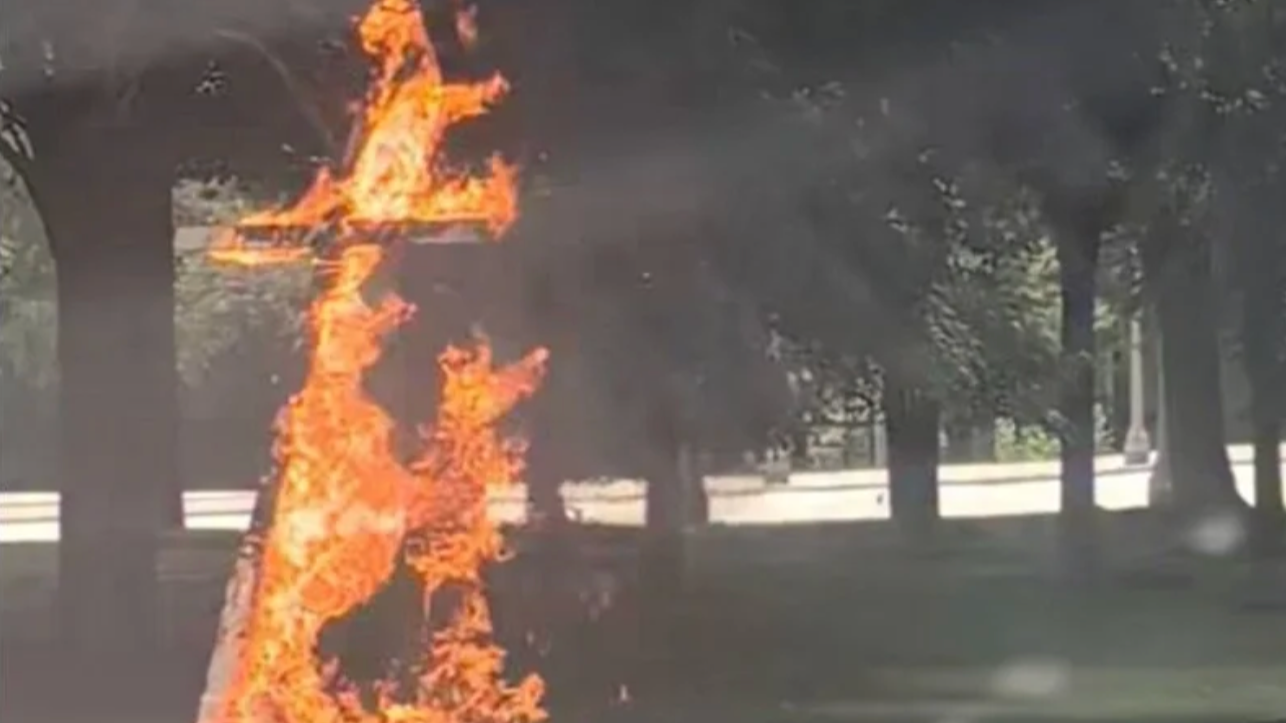
Credit: Keinika Carlton | June 9, 2026.
A data-driven analysis of hate crimes, anti-Black violence, and extremist activity in Chicago and the American North
INTRODUCTION: THE MYTH OF THE SAFE NORTH
When I was a little girl growing up in Oshkosh, Wisconsin, in the 1970s, my white mother used to warn my sister and me (both Black) not to walk past a little white church on our way to school. "That is where the Posse Comitatus meets," she would say. "Don't talk to anyone there." She was very clear in explaining who they were and why they should be avoided. This started when my sister was three and I was five.
Growing up, we were regularly called the N-word, were racially bullied, and had KKK written on our car and school lockers, and often saw confederate flags when we visited our grandparents in rural northern Wisconsin. Police routinely harassed us throughout our childhood and adolescence.
So the idea that real, ugly (and physically dangerous) racism only lives in the South was a myth that I know firsthand.
On June 9, 2026, a burning cross was discovered and extinguished in Chicago’s Grant Park, steps from Millennium Park, in the heart of one of America’s most celebrated cities. Many were shocked but should not have been. The burning cross is not an artifact of the Deep South, nor is it an artifact of a distant past. It is, and has long been, a symbol deployed wherever Black people dare to exist fully, freely, and visibly — including in Chicago, Detroit, Boston, and New York.
For generations, a particular American myth has persisted: that racism, in its most violent and organized forms, belongs only to, and in, the South. This myth has served a political purpose; it has allowed Northern cities, institutions, and its people to position themselves as signs of progress while reproducing the same systems of exclusion, intimidation, and terror they publicly condemned. The data does not support the myth. Nor do the behaviors of native northerners support the myth. Our U.S. history does not support it. And the burning cross in Grant Park does not support it.
THE NUMBERS: HATE CRIMES IN CHICAGO AND ILLINOIS
Hate crimes in Illinois have increased sharply over the past five years. FBI Hate Crime Statistics show that the state had just 98 hate crimes in 2021. By 2023, this number had surged to 347—an increase of 254 percent in two years. Chicago alone reported 326 hate crimes in 2023, showing a 64 percent rise from 2022, with race and ethnicity being significant factors, and religion motivating more than three-quarters of incidents.
In 2024, Chicago hate crimes decreased by 25%. However, this number masks serious issues within specific communities. Hate crimes against Arabs and Muslims rose sharply by 196% after the October 7, 2023, conflict in Gaza. Hate crimes targeting Jewish individuals increased by 58%, making up 37.6% of all reported hate crimes in the city. The Anti-Defamation League reported 1,054 cases of hate, extremism, terrorism, and antisemitism in Illinois from 2020 to 2024, with over half linked to white supremacist propaganda.

HATE GROUPS DON’T LIVE ONLY IN THE SOUTH
The Southern Poverty Law Center tracks 32 active hate groups in Illinois alone. Nationally, the SPLC documented 1,371 hate and antigovernment extremist groups in 2024, a figure that declined to 1,263 in 2025 — but remains at historically elevated levels. Critically, the states with the highest raw numbers of hate groups are not exclusively in the South. California leads the nation with 117 combined hate and anti-government groups. Florida follows with 114. New York is next with 59. We must remember that George Floyd was not brutally murdered in the South but in Minneapolis. Let us not be surprised in the North when our racism shows.
The geographic distribution of organized hatred in America is not a Southern problem. It is an American problem. While Southern states report higher concentrations relative to population, Northern and coastal states host more hate groups in absolute numbers — and those groups operate in the same neighborhoods, schools, and public spaces where Black, Jewish, Muslim, and immigrant residents live.
THE HISTORY THE NORTH FORGOT (Or the history we choose to not see)
Chicago has its own long and well-documented history of racial terror. During the Great Migration, as Black Southerners arrived in the city seeking safety and opportunity, they were met with restrictive housing covenants, redlining, and violent mob attacks. “The Chicago Race Riot of 1919” left 38 people dead and hundreds injured. In the 1950s and 1960s, white mobs attacked Black families who moved into neighborhoods like Cicero and Trumbull Park. Dr. Martin Luther King Jr., who marched in Chicago in 1966, famously said he had “never seen — even in Mississippi and Alabama — mobs as hostile and hate-filled” as those he encountered on the North Side of our city: CHICAGO!
Cross burnings, too, have a Northern history. They have been documented in Illinois, Ohio, Michigan, Boston, Pennsylvania, and New York throughout the 20th and into the 21st century. They are not aberrations in these places. They are part of a continuous thread of racial intimidation that has never required warm weather or a Southern accent.
The myth of the racially safe North isn't merely inaccurate; it is dangerous. It leads northern governments and universities to underinvest in civil rights infrastructure and anti-racist scholarship, under-report hate incidents, and under-prosecute hate crimes. It creates the conditions under which a burning cross in a major American city is treated as shocking, when it should be treated as a predictable consequence of tolerated hate. When it should be met with a policy response to eliminate anti-black hatred and terrorizing.
WHAT THE GRANT PARK INCIDENT TELLS US
The burning cross discovered in Grant Park on June 9, 2026, was not an isolated incident. It occurred against a backdrop of rising hate crimes, an emboldened white supremacist movement, and a national political climate that critics insist has normalized the language and logic of white supremacy and anti-blackness. It occurred in a city where hate crimes rose 64 percent in a single year. It occurred steps from where families — Black, brown, immigrant, Jewish, and LGBTQ+ — gather to enjoy public space.
St. Sabina Church in Auburn Gresham has offered a $10,000 reward for information leading to an arrest. Father Michael Pfleger stated plainly: “This bold rise of racism must be condemned by every race, faith community and Chicagoan.” The investigation is ongoing.
CONCLUSION: SURPRISE IS A PRIVILEGE WE CANNOT AFFORD
The data are clear. The history is clear. Anti-Black hate — organized, violent, symbolic, and systemic — is not geographically contained to any region of the United States. Hate groups operate in California and Illinois as they do in Alabama and Mississippi. Hate crimes are rising in Chicago as surely as anywhere else. And burning crosses have been used to terrorize Black communities from Georgia to Grant Park.
The appropriate response to the June 9 incident is not shock or surprise. Surprise is not an emotion that serves Black communities, or any community for whom the burning cross is intended. Preparedness, solidarity, and accountability do. This is urgent. What this moment requires is the recognition that hate crimes are chronically underreported and under-prosecuted nationwide. It is sustained investment in hate crime documentation, community protection, and accountability. It is sustained investment from our Universities in scholarship and education that racism and other forms of bigotry are real. This is not just history! And it is the honest, overdue reckoning with the fact that the North has never been, nor is it now, the refuge the myth promised.
SOURCES
1.Chicago Police Department — 2024 Annual Hate Crimes Report
2. Hartman, C. (2014, September 17). Cross burning in Harvard Yard? The Harvard Crimson. https://www.thecrimson.com/article/2014/9/17/cross-burning-in-harvard-yard/
3. Chicago Commission on Human Relations — 2025 Hate Crimes Report
4. ADL — Tracking Extremism in Illinois (2025)
5. WBEZ Chicago — Hate Crimes on Rise in Illinois, April 2025
6. CAIR-Chicago — Anti-Arab/Muslim Hate Crimes Up 196% Since Oct. 7
7. Southern Poverty Law Center — Hate Map
8. SPLC — Year in Hate and Extremism 2024
9. Block Club Chicago — Burning Cross in Grant Park, June 9, 2026